

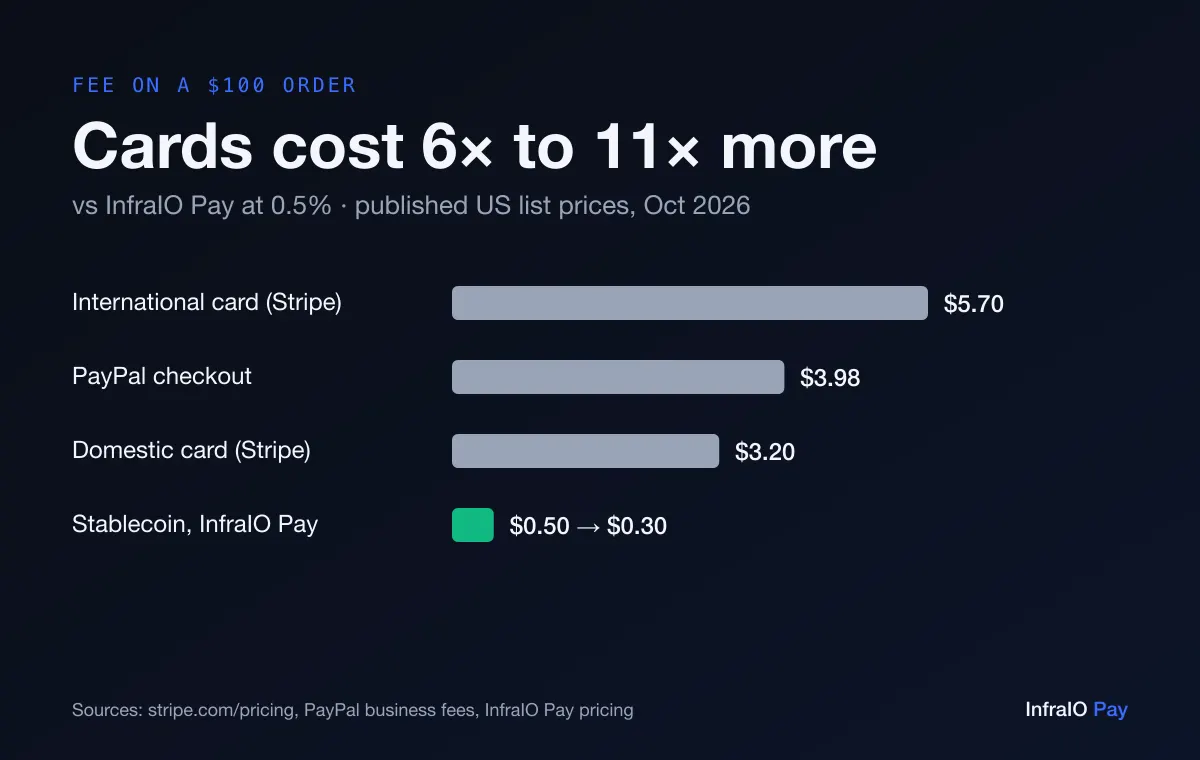
What do card payments actually cost?

A card transaction is not one fee but a stack: interchange (set by the card networks and paid to the issuing bank), network assessments, and the processor's markup. Typical published all-in rates for online card payments sit around 2.9% plus a fixed per-transaction fee, Stripe's standard pricing is a representative public example.

On small-ticket sales that fixed per-transaction component dominates, and cross-border or currency-conversion surcharges push the effective rate higher still.

How much do chargebacks really cost merchants?

Chargebacks are the hidden tax on card acceptance: a disputed transaction can be clawed back long after fulfilment, and each one carries a fee on top of the lost sale. Industry trackers such as the Nilson Report document card fraud losses running into the tens of billions of dollars a year worldwide.

A stablecoin payment has no equivalent. Once the transaction reaches its confirmation threshold on-chain it is final, there is no issuer to reverse it. That removes an entire category of operational cost and dispute-handling overhead.

How fast does each method settle?

Card funds typically reach your account on a rolling multi-day cycle, and processors may hold a reserve. A stablecoin transfer confirms in seconds to minutes depending on the network, and with a non-custodial checkout the funds sweep straight to a wallet you control, there is no processor float and no withdrawal queue.

  • Cards: T+1 to T+3 settlement, possible rolling reserves, chargeback window of months.
  • Stablecoins: on-chain confirmation in seconds to minutes, final, swept to your wallet.

When does crypto checkout win, and when do cards still make sense?

Stablecoins are compelling when your buyers already hold crypto, when you sell cross-border, when chargeback fraud is eating margin, or when card fees are punishing on your average order value. Adoption is broad enough that this is no longer a niche audience, see the Chainalysis Global Crypto Adoption Index for where usage is concentrated.

Cards still make sense when most of your buyers expect them and have no wallet. The pragmatic answer for many merchants is both: keep cards, and add a stablecoin option so the buyers who prefer it, and the cross-border orders cards handle badly, have a cheaper, final rail. Adding crypto with InfraIO Pay costs nothing until a buyer actually pays.