

Why does the network matter for payments?

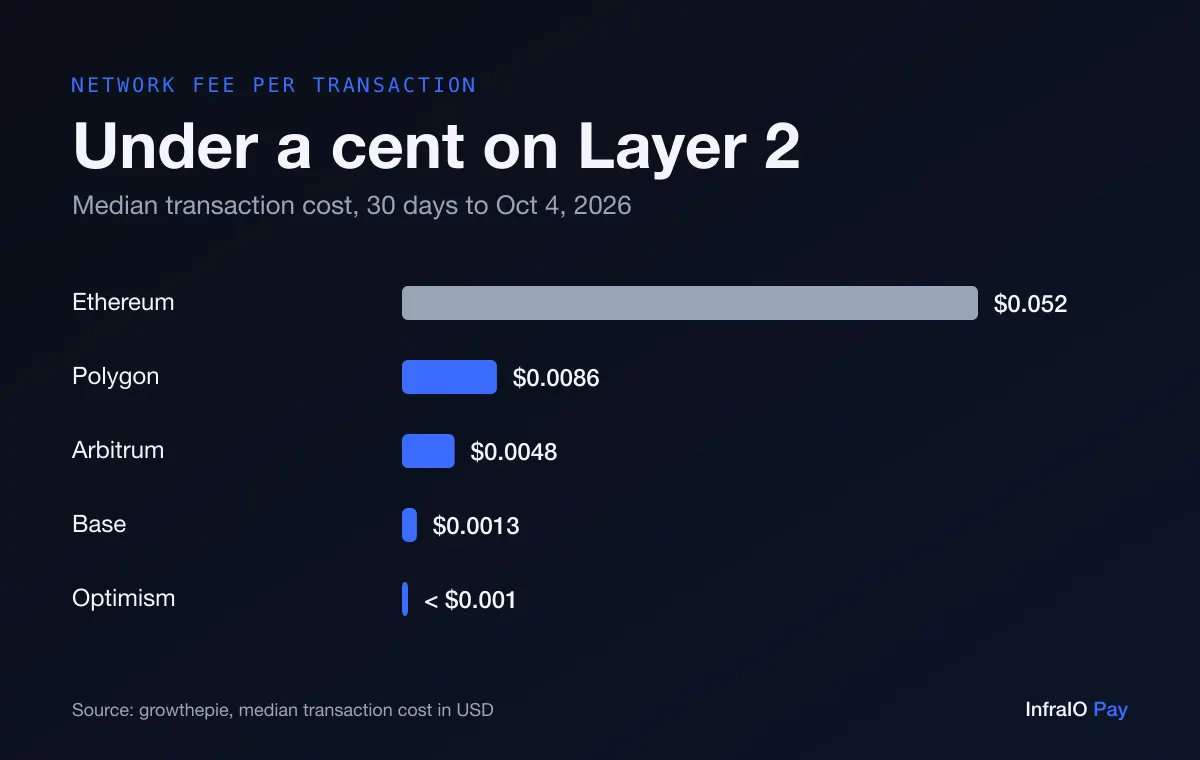
The network sets the buyer's gas cost and how fast the payment finalises. Paying a $20 invoice is painful if network fees are several dollars, so for everyday payments you want a chain where gas is cents, not dollars. That is exactly what Ethereum Layer 2s were built for, ethereum.org's Layer 2 overview explains the model.

USDC and USDT are the same dollar wherever they settle, so the choice is about fees, speed, and where your buyers already hold funds.

How do the main networks compare?

All of these are EVM chains, so the integration is identical; they differ mainly in fees and ecosystem.

  • Base, very low fees, fast, growing consumer adoption. A strong default for new merchants.
  • Arbitrum & Optimism, mature L2s with deep stablecoin liquidity and low fees.
  • Polygon, long-established, cheap, widely supported by wallets and tooling.
  • Ethereum mainnet, highest fees, but some buyers and treasuries prefer to settle there.

How do you compare networks objectively?

Fees and activity shift over time, so check current data rather than rules of thumb. L2BEAT tracks the value secured and activity across Layer 2s, which is a useful proxy for liquidity and maturity when you decide which chains to enable.

Do you have to pick just one?

No. The pragmatic answer is to accept a small set, say Base plus one or two other L2s, and let the buyer choose. With InfraIO Pay you select the token-and-network combinations you accept, the buyer only sees those, and any other EVM chain can be added on request. That keeps checkout simple for buyers while covering where your audience actually holds funds.