

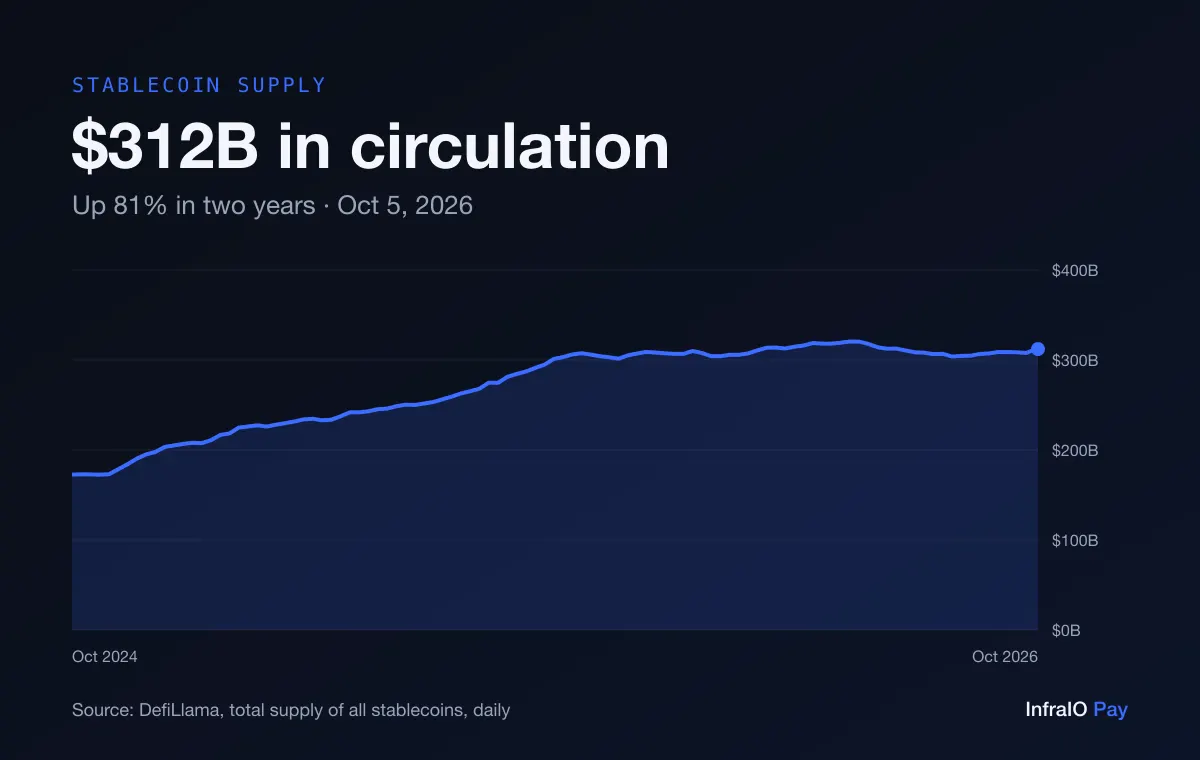
How big is the stablecoin market in 2026?
According to DefiLlama, the total supply of stablecoins was about $312 billion on 5 October 2026. It reached a record of about $321 billion on 17 May 2026 and was about $173 billion in October 2024, so the market has nearly doubled in two years.
Two coins dominate, and both are pegged to the US dollar. Tether's USDT is the largest, followed by Circle's USDC. Together they make up more than four fifths of all stablecoins, which is why most merchants that accept stablecoins start with these two.
| Stablecoin | Supply on 5 Oct 2026 | Share of all stablecoins |
|---|---|---|
| USDT (Tether) | about $184 billion | about 59% |
| USDC (Circle) | about $74 billion | about 24% |
| All stablecoins | about $312 billion | 100% |
Are people actually paying with stablecoins?
Yes, but most of the money moving in stablecoins is still trading and treasury transfers, not shopping. McKinsey and Artemis estimate that real-world stablecoin payments reached about $390 billion in 2025, with business-to-business payments the largest part at about $226 billion. That is still a tiny slice of global payments.
The growth is concentrated where traditional payments are weakest. The Chainalysis 2025 Global Crypto Adoption Index ranks India, the United States, Pakistan, Vietnam and Brazil as the top five countries, and reports that USDT alone moved an average of about $703 billion a month between June 2024 and June 2025.
What changed in stablecoin regulation?
The biggest change is that stablecoins now have their own rulebooks in major markets. For a merchant, that means less doubt about whether the dollar you receive is really backed by a dollar.
- United States. The GENIUS Act was signed into law on 18 July 2025. Issuers must be licensed, must hold reserves of at least one dollar for every stablecoin, and may not pay interest to holders. The OCC proposed its implementing rules in February 2026, and the law takes effect by 18 January 2027 at the latest (Mayer Brown).
- European Union. The stablecoin rules of MiCA have applied since 30 June 2024, and the transition period for crypto service providers ended on 1 July 2026 (ESMA).
- Japan. JPYC, the first yen stablecoin issued under Japanese law, launched on 27 October 2025 (The Block).
- United Kingdom. The FCA published its final core rules for crypto assets, including stablecoin issuers, on 30 June 2026 (Skadden).
- Singapore. MAS opened a consultation on the laws for its stablecoin framework on 1 September 2026 (MAS).
Which big payment companies have moved into stablecoins?
In the last eighteen months the largest names in payments have started to use stablecoins themselves:
- Shopify began letting merchants accept USDC on the Base network on 12 June 2025, with Coinbase and Stripe. Merchants receive local currency by default, or can claim USDC to their own wallet (Shopify).
- Stripe extended stablecoin payments to 32 more markets at its Sessions event on 29 April 2026 (Stripe). Tempo, the payments blockchain led by Stripe and Paradigm, went live on 18 March 2026 (CoinDesk).
- Visa launched USDC settlement for US banks on 16 December 2025 and reported a $3.5 billion annualised stablecoin settlement run rate as of 30 November 2025 (Visa).
- Mastercard completed its acquisition of the stablecoin infrastructure company BVNK, a deal worth up to $1.8 billion, on 3 August 2026 (The Block).
What does this mean for an online store?
Three things. First, the buyers are real: millions of people already hold dollars on-chain and want places to spend them, especially in markets where cards and bank transfers are slow or expensive. Second, clearer rules make USDC and USDT safer to hold as working capital. Third, because stablecoin payments are still a small share of shopping, they work best as an extra option next to cards, not a replacement.
There is also a real choice in how you receive the money. Some providers convert stablecoins to local currency for you and pay out on a schedule. A non-custodial gateway like InfraIO Pay forwards each payment to a treasury wallet that only you control, within minutes, for a platform fee that drops from 0.5% to 0.3% as your volume grows (pricing).
If you are deciding which coin and network to accept, see USDC vs USDT for merchants and which network to accept.
What risks should merchants keep in mind?
Stablecoins are not risk-free, and it is better to know the limits up front.
- Issuers can freeze tokens. Both Circle (USDC terms) and Tether (legal terms) reserve the right to block addresses, usually on legal or law-enforcement grounds.
- Rules are still being finished. US implementing rules and the UK regime are not fully in force yet, and details can change.
- Payments are final. There are no chargebacks on-chain, so refunds are a deliberate action you take, not something a bank forces.
- Tax and accounting. In the US the IRS treats digital assets as property (IRS). Rules differ by country, so check with your accountant.