
What is a multisig wallet?
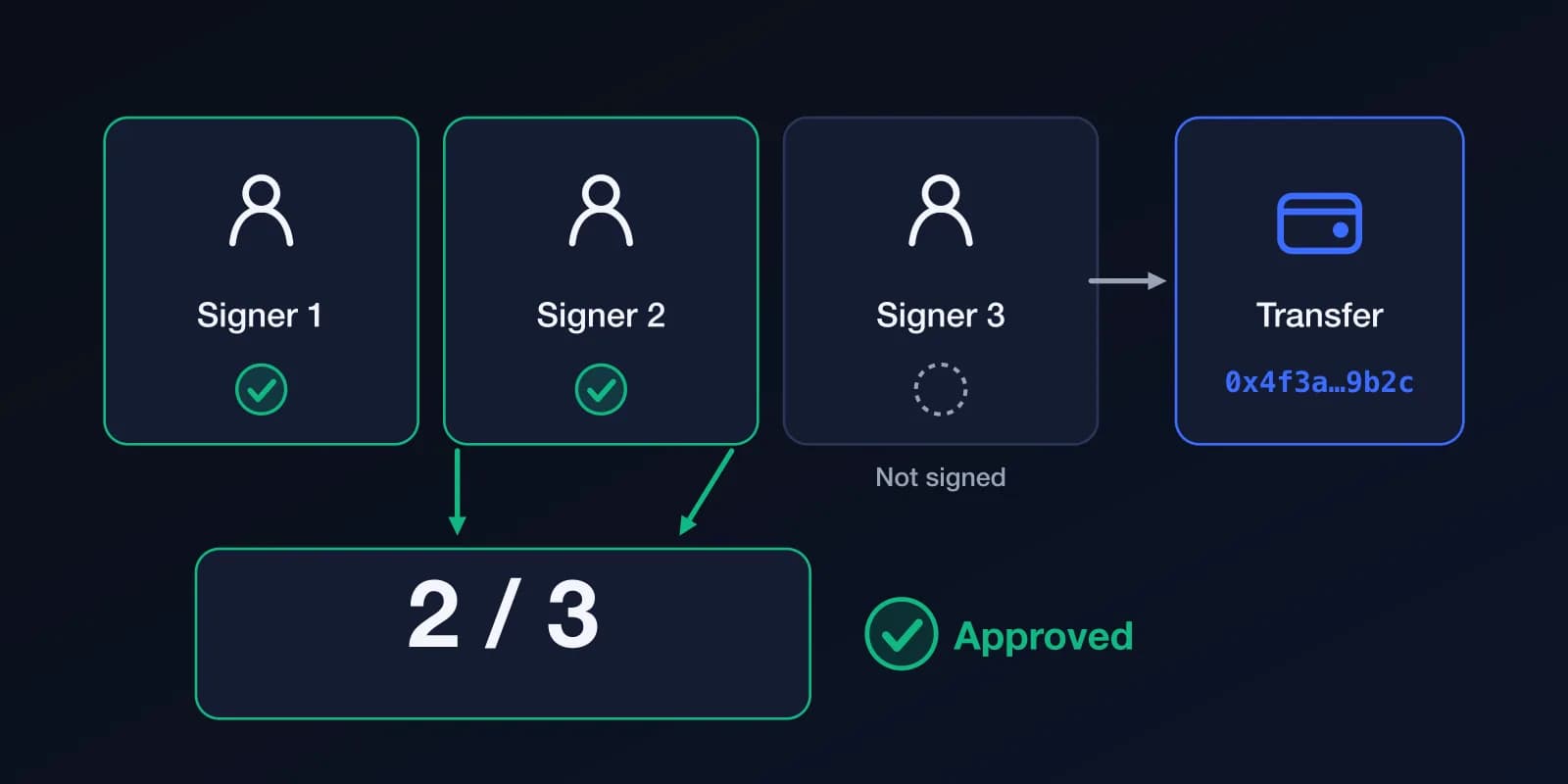
"Multisig" is short for multi-signature. In a normal wallet one key approves everything: whoever holds it can move all the money. In a multisig wallet the approval is shared, and a transfer only goes through when enough of the signers have approved it. (Safe docs)
Think of a joint bank account that requires two signatures on every cheque, or a company safe that opens only when two managers turn their keys together. No single person, and no single stolen or lost key, can empty it alone.
How does M-of-N work?
The rule is written as two numbers. N is how many signers the wallet has. M is how many of them must approve each action. A few common setups:
| Setup | Who must approve | Typical use |
|---|---|---|
| 1 of 1 | The one signer | An ordinary personal wallet |
| 2 of 2 | Both signers, every time | Two partners who must always agree |
| 2 of 3 | Any two of three signers | A family, or a small team with a spare |
| 3 of 5 | Any three of five signers | A company treasury or a board |
Who needs a multisig wallet?
Anyone for whom "one person, one key" is a risk rather than a feature:
- Families and couples who want savings that need two approvals, or a trusted relative as a safety net.
- Small teams and startups where no single person should be able to move company funds.
- Businesses and treasuries that need approvals, an audit trail and protection against a single mistake or a single compromised laptop.
- Individuals with a lot at stake who want a second device or a second person as a check on their own wallet.
How is InfraIO Wallet different from a classic multisig?
Classic multisig wallets such as Safe are powerful, and they are usually something you set up on purpose: you choose the signers and the threshold first, and every signer needs their own wallet. That is a good fit for teams that already know they need it, and a lot of ceremony for everyone else.
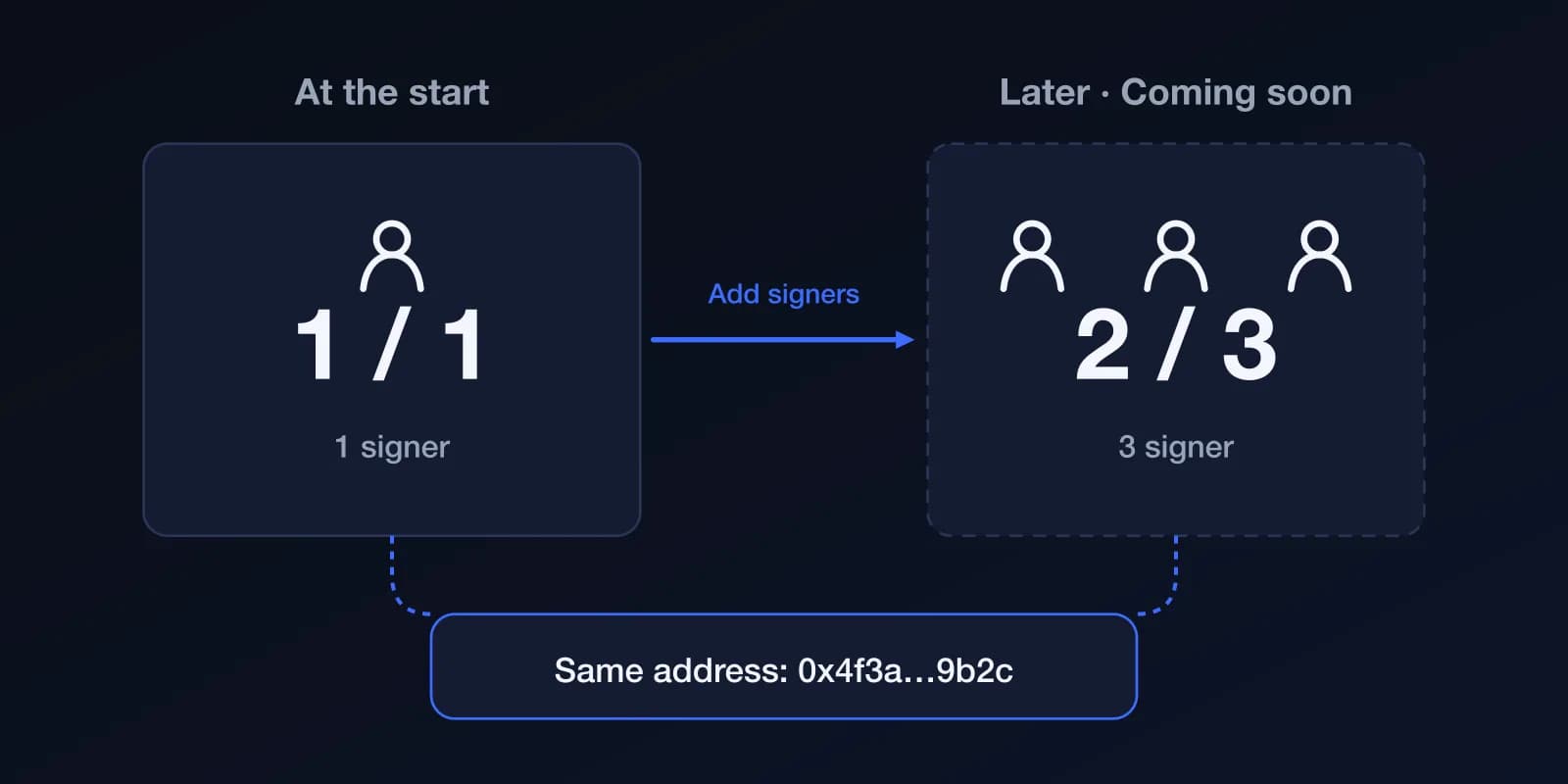
InfraIO Wallet takes the opposite path. Every wallet starts as a multisig with one signer and one required signature (1 of 1). Day to day it works like any other wallet: you open it with a passkey, which is Face ID, a fingerprint or your device passcode (see how the wallet works and passkeys vs seed phrases). The multisig is already there, waiting for the day you need it.
Later you will be able to add signers: another passkey on another device or for another person, or an external wallet such as MetaMask. Your address does not change, so there is nothing to migrate and no need to move funds to a new wallet.
What are the rules once you add signers?
These rules describe the planned multisig feature, which is coming soon and not available yet.
With one signer, that person decides alone, exactly as in any normal wallet. Once there are two or more signers, the rules tighten for everyone, including the owner: (Safe docs)
- Every transaction needs the agreed number of signatures, for example 2 of 3.
- Every change to the wallet needs them too: adding or removing a signer, or changing how many signatures are required.
- The wallet address stays the same throughout.
What are the best practices for a multisig wallet?
A few habits make a multisig wallet much safer:
Keep reading: What is a crypto wallet?, How crypto wallets get hacked, How to use InfraIO Wallet, InfraIO Wallet
- Do not set M equal to N. With 2 of 2, losing one signer locks the wallet for good. 2 of 3 lets you lose one and carry on.
- Keep a backup. Spread signers over different devices and people, and keep a backup passkey or an offline recovery phrase for each one you control.
- Do not put all signers in one place. Three passkeys on the same phone are still one point of failure.
- Know your external signers. A MetaMask signer is protected by its own recovery phrase, so it is only as safe as that phrase. (MetaMask)
- Try it with a small amount first, and write down who the signers are and what the rule is.
- Remember that signing is still your job. A multisig adds a check, but it does not stop all of you from approving something malicious.